

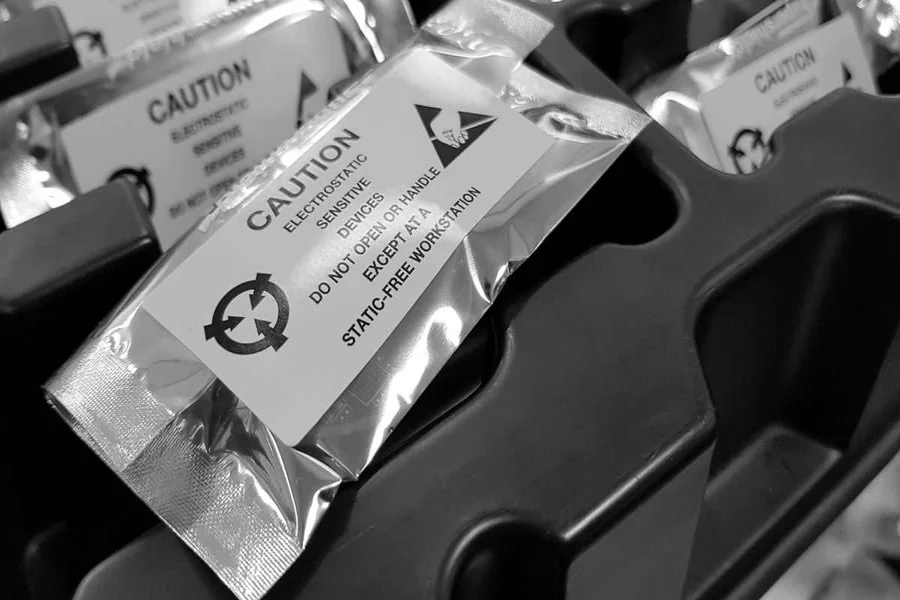
Electronic components often travel inside specialized protective bags. The label should identify the sealed component without damaging the bag or interfering with its handling procedure. An ordinary thermal label should not be described as ESD safe simply because it sticks to an ESD bag; evaluate the complete package and facility rules.
Preserve the Protective Barrier
Do not place a label across a heat seal, fold, inspection window, or opening point. Keep the bag intact when removing or replacing labels. If a serialized part moves between bags, record the transfer and verify the part number against the component itself before applying a new outer ID. A perfect label on a compromised bag does not protect the contents.
Keep Traceability Fields Clear
A short part number, lot, quantity, and storage status can be enough for a scan at receiving. Link any detailed handling history to the system record. If multiple barcodes are printed, identify which one the receiving scanner expects. Do not assume a code on the bag replaces the manufacturer markings on the component or reel.
Validate Adhesive on Actual Bag Film
Static-shielding and antistatic bags can have different outer surfaces. Test label adhesion on each qualified bag supplier’s material after normal storage and bag flexing. Check whether removal damages the film or leaves residue in a clean work area. Have the facility’s ESD control owner review the proposed labeling process before introducing a new adhesive or applicator.
Manage Opened and Resealed Bags
Once a bag is opened, its status may change. Use a controlled reseal or replacement procedure and update the system rather than writing over a label. Remove obsolete status marks so receiving staff see one current instruction. If the remaining quantity changes, print a new label from the verified record and reconcile it with the physical count.
Define the Job Before Choosing Stock
Write down exactly what the label on ESD protective bags must accomplish during the component’s storage and transport interval. Decide which field a worker reads, which code a scanner captures, and when the information can be retired. The working data may include part number, lot, quantity, and handling status; distinguish fields that must be printed from those better kept in the inventory system. Decide who owns an incorrect record and how it is corrected. A label specification based only on dimensions misses the process that gives the printed mark its meaning.
Match Adhesive to the Real Surface
Test the proposed adhesive on static-shielding and antistatic electronic component bags, using the exact material supplied to production. Apply it at the normal work area temperature and inspect it after the planned dwell, not only after a few minutes. The main challenges here are bag seals, handling controls, and variable surface treatments. A stronger adhesive may hold better but can create residue or damage during removal. If direct application is unreliable or undesirable, assess an outer carton or controlled tag. Keep approved samples from each packaging or carrier supplier so a later material substitution triggers a targeted retest.
For this application, compare ESD bag labels on the actual static-shielding and antistatic electronic component bags and through the planned handling interval. Ask for samples before choosing a full production roll.
Choose the Roll and Printer Together
Confirm print width, label height, gap or black-mark sensing, roll core, outside diameter, winding direction, and printer feeding limits before ordering. A roll that shares the same face dimensions can still jam or print backwards if its core or winding is wrong. Use the production template and print a long enough run to reveal feed drift, adhesive ooze, or die-cut variation. Record the approved printer settings with the roll specification. Recheck them when a device, converter, or template changes.
Make Every Scan Deliberate
Design the barcode for the scanner and distance used with ESD protective bags. Leave the required clear margin, preserve contrast, and keep the code away from folds, seams, edges, or moving parts. Put the most useful human-readable identifier beside it so staff can spot a mismatch. If more than one code appears on the object, state which workflow uses each one and remove obsolete routing codes. Print the longest data value and smallest label in the test set; a short sample code can hide layout problems.
Apply the Label at a Repeatable Point
The preferred position is a flat outside panel that does not cross the heat seal. Apply only after the object or package has reached the form it will have during normal handling. Remove loose dust or moisture where the process permits, press across the entire label, and check the corners. Give workers a simple placement guide showing the approved zone and the areas to avoid. If the application surface changes between suppliers or batches, check a few finished units before the shift continues. An attractive label applied in the wrong place is still a failed label.
Run a Trial That Mirrors Use
Print a production roll and test it on the hardest version of ESD protective bags, then follow it through the component’s storage and transport interval. Check printer feed, initial readability, adhesion, edge lift, and scanning at each real handoff. Include the worst expected combination of bag seals, handling controls, and variable surface treatments. Keep both successful and failed examples with the time and conditions recorded. If a sample fails, change one factor at a time, such as placement, adhesive, size, or print settings. This makes the result useful for purchasing rather than a vague pass or fail.
Control Reprints and Old Labels
A torn label, wrong template, or corrected record needs an explicit replacement path. Reprint from the verified current record, not from memory or a photograph of the old label. Where identifiers are unique, preserve the link to the original record and mark a failed print as void if the system supports it. Remove or cover an obsolete active code so a scanner cannot select the wrong one. Document who authorizes a new label when the physical item and the digital record disagree.
Give the Supplier an Approval Specification
Send a sample of static-shielding and antistatic electronic component bags, the printer model, a dimensioned label drawing, roll geometry, required data and barcode layout, expected life, and the environmental conditions described above. Ask for converted-roll samples of the proposed construction. Agree on the acceptance test before a bulk order, including feed performance, scan success, bond after normal handling, and removal behavior when relevant. Record the approved material, adhesive, liner, die cut, and winding as one controlled specification. Compare cost per successfully labeled unit rather than only the blank-label price.
When evaluating direct thermal labels for ESD protective bags, give the supplier the real surface, printer details, and pass criteria rather than a size alone.
